Monday, June 13, 2016

Field work task 1

Task 1-

The effective teaching principle the teacher I observed uses the principle of differentiation to reach every child in her classroom. Differentiation in schools is so important because it is important to teach diverse learners in such a diverse school. Differentiation is the concept of teaching in a variety of ways to meet the needs of all your students. There are many ways to go about this including have a wide variety of materials, different teaching methods to help the different learning styles of your students and using a variety of grouping strategies. Different grouping strategies that  Ms. R thinks is important be successful includes interviews, literature circles and turn and talks. I plan on using all of these strategies in my future classroom because I think it is very important to allow children to learn from each other. Also, she thinks it is important to allow them to work in partners because this is something they will see throughout their school careers and in life. It is important to teach students from an early age that working together is beneficial to see different aspects and ways of doing things so they know there is more than just one way of doing things. The research on differentiations is an effective teaching strategies that empowers teachers’ continued learning process because new research and studies are always coming out so it is so important to be up to date on the current findings to better help your students. 


Saturday, June 11, 2016


Power point-http://screencast-o-matic.com/watch/cD1Xo2iDFj

Caitlin Higgins   
ED 5410
Theorist in Educational Psychology
Summer I 2016
B.F. Skinner and Theories
Burrhus Frederic Skinner was born on March 20, 1904 in Susquehanna Depot, Pennsylvania and died on August 18, 1990 in Cambridge, Massachusetts of Leukemia.  As a child B.F. Skinner enjoyed school and learning and had a relatively uneventful childhood until his brother died at the age of 16. Skinner attended Hamilton College in New York and received his Bachelors in English Literature in 1926. He then attended Harvard University for graduate studies, where he would perform very important research and later become a professor at.  He went to graduate school to study psychology and behaviorism after meeting John B. Watson and getting inspired by him and his work in Behaviorism. In 1937, Skinner married Yvonne Blue and they had two daughters Julie and Deborah. Throughout his life B.F. Skinner was an author, psychologist, philosopher and an inventor; he made large discoveries and added to advancements in the field of psychology
B.F. Skinner was influenced by the works and theories of Watson, Pavlov and Thorndike, and he used their theories to shape his own based off aspects of their theories he did or did not agree with.  Skinner was influenced by Ivan Pavlov and his theory of classical conditioning (later developed by John Watson) which involved learning to associate an unconditioned stimulus that already brings about a particular response (i.e. a reflex) with a new (conditioned) stimulus, so that the new stimulus brings about the same response. John B. Watson was a huge influence to Skinner, he invented the study of behaviorism and his experiments such as Little Albert and Animal Education were very influential to many psychologist, especially B.F. Skinner, “In 1913, Watson published the article "Psychology as the Behaviorist Views It”, which is sometimes called "The Behaviorist Manifesto". In this article, Watson outlined the major features of his new philosophy of psychology, called "Behaviorism” (Day, 2016). And Edward Thorndike and his learning theory that lead to the development of operant conditioning within behaviorism. In his theory classical conditioning depends on developing associations between events, operant conditioning involves learning from the consequences of our behavior. Skinner even modeled his Skinner Box after Thorndike’s Puzzle Box (McLeod, 2007).  In the 1920’s, Watson had left the field of academic psychology, and Skinner saw his opportunity to get in the field by working off of and building off of Pavlov’s and Watson’s idea of classical conditioning, “Skinner's views were slightly less extreme than those of Watson. Skinner believed that we do have such a thing as a mind, but that it is simply more productive to study observable behavior rather than internal mental events. The work of Skinner was rooted in a view that classical conditioning was far too simplistic to be a complete explanation of complex human behavior. He believed that the best way to understand behavior is to look at the causes of an action and its consequences. He called this approach Operant Conditioning” (McLeod, 2007). Skinner built upon research that was previously done and used their findings and his thoughts on their findings to shape and create his ideas of Operant Conditioning.
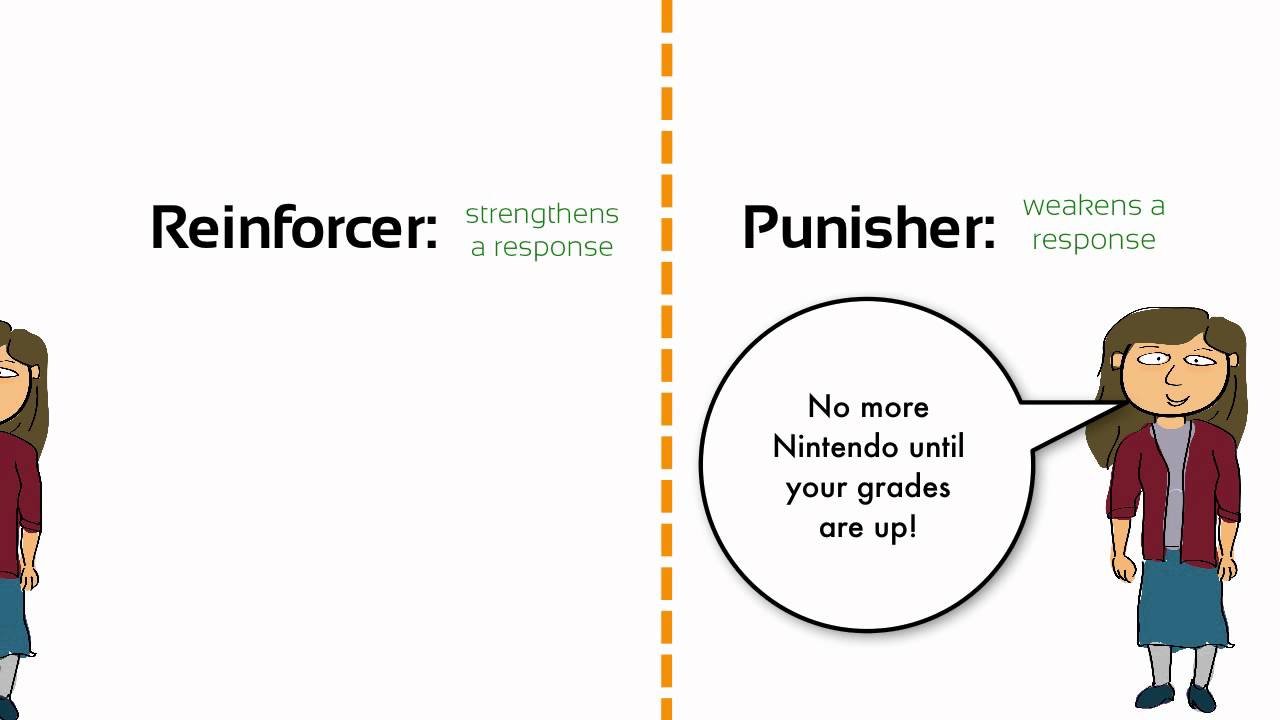
In 1938 B.F. Skinner created the term Operant Conditioning, which is defined as the changing of behavior by the use of reinforcement, which is given after the desired response (McLeod, 2007). Skinner created an operant conditioning chamber known as the Skinner Box to measure the operant conditioning effects on animals including rats and pigeons, “A Skinner box, also known an operant conditioning chamber, is an enclosed apparatus that contains a bar or key that an animal can press or manipulate in order to obtain food or water as a type of reinforcement” (Debell, 1992).  The reinforcements must be given after the desired response to increase or decrease the desired behavior. Skinner identified three types of responses that can follow behavior, these are neutral, reinforcements and punishments.  Neutral operant is a response from the environment that neither increases nor decreases the probability of a behavior being repeated.  A reinforcement, is a response from the environment that increases the probability of a behavior happening again. Reinforcements can be either positive or negative, but both increase a desired behavior.  And punishers are the last kind of response, and are a response from the environment that decreases the likelihood of a behavior being repeated. Skinner’s theory of Operant Conditioning has had lasting effecting in both psychology and academic psychology (Woolfolk, 2013).
Operant conditioning can be used in the classroom to shape performance and can be used in classroom management techniques. Providing feedback can be instrumental in shaping of behaviors or performance in the classroom.  This can be done by the use of affirmation and compliments to give positive reinforcement of good behaviors. Positive reinforcement strengthens a behavior by providing a consequence an individual finds rewarding. Negative reinforcement is the removal of an unpleasant reinforcements can also strengthen behavior. In the classroom negative reinforcements can include: a student being ignored for inappropriate behaviors. Punishments in the classroom to decrease an undesired behavior can include phone calls home for tardiness or being unprepared (McLeod, 2007). Applied Behavior Analysis formed from the operant conditioning theory it refers to Antecedent, Behavior and Consequence, the three building blocks of analyzing and changing challenging or difficult behaviors. Antecedent is the environment the events or behavior that precedes the Behavior of Interest. Behavior has to do with the behavior that you are focusing on, it may lead to other undesirable behavior, or contributes to other undesirable behavior. Consequence is the outcome a child's behavior of choice with the related outcome. Skinner made huge discoveries in the field of psychology, but made advancements in the way learning is considered to happen and how to best aid this.  He believed education had two purposes: to teach verbal and nonverbal behavior and two aid student’s interest in learning.  He thought teachers must know effective ways of teaching based off student’s behaviors.  Skinner believed that for students to learn they must be engaged and motivated to learn not just passively accepting new information, they must be interested. The motivation to learn is different for everyone so you must figure out the best way to motivate and reinforce them to learn (Friedrichs, 1974).
Skinner’s work made vast developments in the field of psychology and academic psychology, and influenced many other psychologist and philosophers after him. Some of the psychologist that came after Skinner that were inspired by his work in behaviorism and operant conditioning include: Kohler, Premack and Bandura. In 1924, Kohler found that primates often seem to solve problems in a flash of insight rather than be trial and error learning. Also social learning theory by Bandura in 1977, suggests that humans can learn automatically through observation rather than through personal experience. Both of these psychologist were influenced and inspired by Skinner’s work and build off of and improved his theories just as Skinner had done with his influences.


References
Day, R. K. (2016). B.F. Skinner, Ph.D. and Susan M. Markle, Ph.D.: The Beginnings. Performance Improvement, 55(1), 39-47. doi:10.1002/pfi.21549
DeBell, C. S. (1992). B.F. Skinner: Myth and Misperception. Teaching  Of Psychology, 19(2), 68.
Friedrichs, R. W. (1974). THE POTENTIAL IMPACT OF B. F. SKINNER UPON AMERICAN SOCIOLOGY. American Sociologist, 9(1), 3.
McLeod, S. A. (2015). Skinner - Operant Conditioning. Retrieved from www.simplypsychology.org/operant-conditioning.html
Watson, J. B. (1913). Psychology as the Behaviorist views it. Psychological Review, 20, 158–177.
Woolfolk, Anita (2013) Educational Psychology (13th ed.) Needham Heights Massachusetts: Allyn and Bacon


Monday, June 6, 2016

Chapter 7 Questions

  1. Reflect on your own learning. What examples of learning qualified as such according to the behaviorist perspective?]
I think the majority of my learning qualified as such according to the behaviorist perspective. Learning is a permanent change in knowledge or behavior due to experience. Everything from wanting to perform well to receive a good grade to the proper ways to act in class were taught by behaviorism. Behaviorism is a change in behavior due to an experience (reinforcement and punishment). A reinforcement is an increase of a desired behavior, an example of this would be studying for a test will make you perform better and receive a good grade. A punishment is a decrease of undesired behaviors, and example of this is being unprepared for class will make the teacher call your parents. Both behaviors are being shaped by their outcomes and the thoughts and experiences related to both.

     2. What is the primary difference between classical and operant conditioning? How might the difference affect learning?
Classical conditioning in an involuntary or automatic behavior (Pavlov's dog). If you normally don't perform well in math, starting a new topic might make you anxious. This behavior is not thought about it is a natural consequence to previous experiences. Operant conditioning uses consequences, rewards and punishments after the behavior. An example of operant conditioning is being rewarded by completing all assignments by having your lowest grade dropped. 

     3. What is the difference between positive reinforcement and negative reinforcement? 
Positive reinforcement is presenting a motivating or reinforcing stimulus after a desired behavior. This then makes the desired behavior more likely to happen in the future. A negative reinforcement is when a certain stimulus is removed after a behavior. This increases future behavior because of removing or avoiding a negative consequence, it is increasing a behavior not decreasing so it is different than a punishment. 
      4.  What is the difference between negative reinforcement and punishment? What are the potential unintended consequences of mixing these up?
A punishment is a decrease of an undesired behavior. While A negative reinforcement is when a certain stimulus is removed after a behavior. This increases future behavior because of removing or avoiding a negative consequence, it is increasing a behavior not decreasing so it is different than a punishment. A negative reinforcement is different than a punishment because it is increasing a behavior not decreasing.


Saturday, June 4, 2016

Resources for Elementary Age Children

                                                                         References

http://www.simplypsychology.org/piaget.html
-Piaget

http://www.learning-theories.com/vygotskys-social-learning-theory.html
-Vygotsky

https://www.verywell.com/developmental-milestones-for-elementary-school-621042
-Developmental Milestones

http://geography.about.com/od/teachgeography/a/Teaching-Global-Education-In-The-Classroom.htm
-Global Learning

http://www.aboutkidshealth.ca/En/HealthAZ/DevelopmentalStages/SchoolAgeChildren/Pages/Physical-Development.aspx
- Developmental stages

http://www.education.com/reference/article/emotional-development/
-Emotional development

http://www.edutopia.org/blog/elementary-social-emotional-curriculum-2-appreciation-randy-taran
-helping build social and emotion development

http://www.classroominterpreting.org/Interpreters/children/Cognitive/earlyelem.asp
-cognitive development 8-11

http://specialed.about.com/od/iep/a/accomod.htm
Accommodation for students with special needs

Friday, June 3, 2016

Extra! Extra! Reflections

I really enjoyed watching these videos and took many important ideas away from them. In the Toward New Understanding of Mental Disorders I think it is important to rethink the ways we see mental disorders. I like the idea of thinking and referring to them as Brain Disorders because that is what they really are. I think this new name really takes the stigma off Mental Disorders and shows it for what is really going on. When they compared the average brain and the brains with PTSD, OCD and Depression, there are clear differences. I think some people see people suffering with Mental Disorders or Brain Disorders as being weird or having something wrong with them, but people who have heart attacks and Alzheimer's are felt bad for.  I really liked this point he made and it really made me think why people with Schizophrenia and Alzheimer's are treated so differently and the stigmas they both go through. I think this video and ideas like this should become more popular so we can think of Mental Disorders as health problems and change the way we see people that suffer with them.

In the Dyslexia video I really liked the simulation because for me it clearly showed how it might feel having dyslexia. Before watching the video I did think it was just as simple as seeing d as b. It is really important for teachers to go through simulations of disorders their students might be facing to give them a small feeling of how the student feels everyday. They will then have a better understanding on what the child goes through and way to help them. The time they spend decoding words will put them behind their peers and this is something they know and worry other students will notice as well. Dyslexia effects 1 in 5 children, which is 20%  of students so it is important to know how to help such a large population of your students!


Wednesday, June 1, 2016

Student engaged assessments videos

I really enjoyed watching some of these videos because its nice to see what other teacher's do and what works and doesn't work. This way you can learn from their successes or failures and see how you can implement similar ideas in your own classroom. Its nice to learn from others because it really does take a lot of stress away and allows you to think of how you can improve or put your own spin on things that work.
 I liked the First and Last 5 Minute video because I think these are the most important time slots in the classroom. It sets up the foundation for learning for that day and get kids thinking and engaged the minute they walk through the door, so there is no time wasted. Entrance and exit tickets can be great for having children reflect and make the next steps clear. I liked in the video where the teacher had they write down any important advice or steps to help them tomorrow. This helps them remember and write future notes to themselves which is something I like because I do it with myself and my own learning. The First 5 Minutes allows to think of previous knowledge or building off ideas they learned the day before and I think takes a lot of stress and pressure off students by giving them a warm up they may receive participation points for but isn't being graded in dept. The exit ticket allows them to reflect on information learned that day and tests for the knowledge they gained from the lesson and whether they grasped the information or not. These are both activities I plan on using in my future classroom!


The second video I enjoyed watching was the interview with a 4th grade teacher. I liked learning how she created a class culture and had all of her students what was needed on their own. She set up her students for success by giving them the skills and rules they need to be independent. They talked about how they wanted their classroom to look (organized, safe and clean) and help the students responsible for this. By giving students responsibilities they felt more independent and were acting more mature because of this. I liked that she doesn't have class jobs because everyone show help everyone all the time. If someone sees something not being done they will do it instead of thinking it is someone else's job or responsibly. And I also took away from the video how she uses her quiet voice to get the attention of the students. Because if they see her mouth moving but can't hear her they will listen instead of speaking. This also sets the tone of the class, of talking quietly and calmly and will help the students learn to act accordingly.