Monday, June 13, 2016

Field Work Task 5

Task 5-
I observed many examples that show children’s cognitive, social, emotional and physical development. I observed a fourth grade classroom and observed students with different level of fine motor skills. One boy in the classroom has Autism and he had very low fine motor skills so he uses a computer to type his notes in class. I observed that the girls were taller and weighed more than boys, which goes with what I read in chapter three. The teacher let them use a lot of model centers and interviews to make learning more fun and allow them to experiment socially in their environment. Children develop at different rates and are developing in different areas but gradually. Their brains are shaped by activity, culture, content and experiences. So as teachers it is so important to give students the opportunity and experiences they need to grow because they may be missing out on crucial experiences based off their cultures or socioeconomic situations.


Field Work Task 4

Task4-
While observing the classroom I noticed individual needs of students some of these include: print awareness, improving reading concepts, teaching comprehension strategies and the important of using open ended questions. I also saw the importance of print concepts, phonemic awareness and a desire to learn to read and write, all of which I saw in my teacher’s classroom, through the use of posters, charts and access to a lot of books. Having a print-rich classroom is really important I learned because it encourages and promotes reading, this is something I saw a lot of students needing. Something else I took away from observing was the importance and need of the foundational activities that include storytelling, read alouds, and model centers. I like the ideas of the model centers because it shows real life situations and how print is everywhere in the world. In the model centers I observed, students are presented with a mock restaurant or doctor’s office which allowed for real world situation to take place in the classroom. I think this is a good idea because children get to get out of their seat and use their imagination, reading a menu or a chart in the doctor’s office. This would also offer a more diverse and different approach to reading then just books and the students really seemed to enjoy them. I think this would get the students interested in reading, out of their chairs and getting some of their energy out in a productive way. The most important thing I took away from this observation though was the importance of having a lot of books. They show different comprehension strategies such as calling on prior knowledge, predicting, questions, wondering what will happen next and determining the most important details. I think it is very important to teach student these strategies because I think often it is something we assume students know. If a child is reading and not understanding the text it is probably because he hasn’t developed these skills. It is also important to have a large variety of lessons to allow for differentiated learning. Open ended questions promote comprehension and understanding, instead of asking yes or no answers. I also saw a need for learning through fun activities, this get students engaged and more motivated to learn. Instead of a quiz on a class wide book they read, the teacher had them break off into different groups and do an Oprah Winfrey interview with one another. I also like the idea of the Oprah Winfrey Interview and plan on implementing them in my future classroom. I think it is fun and allows students to make connections and encourages a deeper understanding. Students must either learn in-depth about an author or individual to be able to pretend to be them or the students who are the interviewer or asking the questions show they understood the material by asking questions to the interviewee and fosters literature conversations.


Field Work task 3

Task 3-

I observed in a fourth grade classroom, at this age of development children are growing cognitively, socially, and morally. Ms. R said she liked to teach her students the skills they’ll need to be successful in all areas. She thinks one of the best ways to teach this is allow them to learn from each other. She uses the child development characteristics in her lesson which includes using multiple intelligences to count, talk about with partner and talking through different problems. This uses Gardner’s Theory using the linguistic, interpersonal, and intrapersonal. Allowing the students communicate with each other allows them to learn and collaborate with one another. Ms. R uses Zone of Proximal distance in her lesson to give students confidences to do work and then slowly backing off so they can do what they can on their own. She said that students are on all different levels of developing so it is so important to learn about your students and what they can do and what they need help with in planning your lessons. If children are developing similarly you can group them and allowing them to work and build off each other. Depending on the assignment she will group stronger students with students a little behind to learn and work together and build positive peer relations. 


Field Work task 2

Power Point!


Task2-
·         The first person interviewed named being resilient, understanding and compassionate as three characteristics shared by intelligent people.
·         The second person interviewed said that being hard-working, pushing boundaries and being able to work/learn from others as three characteristics shared by intelligent people.
·         The third person interviewed stated that three characteristics shared by intelligent people are being able to take criticism, always wanting to learn new things, thinking innovatively


Summary:
■All people interviews thought that intelligent people are never done learning. They want and have a need to learn new concepts and ideas. Working together was another common theme in the answers. Intelligent people like working together and learning from one another because it is a fast and productive way to learn, by learning from others. They collaborate and work well with others and are team players. Thinking of new ways to solve problems and being innovative was another answer shared by some of the other people interviewed. 


Field work task 1

Task 1-

The effective teaching principle the teacher I observed uses the principle of differentiation to reach every child in her classroom. Differentiation in schools is so important because it is important to teach diverse learners in such a diverse school. Differentiation is the concept of teaching in a variety of ways to meet the needs of all your students. There are many ways to go about this including have a wide variety of materials, different teaching methods to help the different learning styles of your students and using a variety of grouping strategies. Different grouping strategies that  Ms. R thinks is important be successful includes interviews, literature circles and turn and talks. I plan on using all of these strategies in my future classroom because I think it is very important to allow children to learn from each other. Also, she thinks it is important to allow them to work in partners because this is something they will see throughout their school careers and in life. It is important to teach students from an early age that working together is beneficial to see different aspects and ways of doing things so they know there is more than just one way of doing things. The research on differentiations is an effective teaching strategies that empowers teachers’ continued learning process because new research and studies are always coming out so it is so important to be up to date on the current findings to better help your students. 


Saturday, June 11, 2016


Power point-http://screencast-o-matic.com/watch/cD1Xo2iDFj

Caitlin Higgins   
ED 5410
Theorist in Educational Psychology
Summer I 2016
B.F. Skinner and Theories
Burrhus Frederic Skinner was born on March 20, 1904 in Susquehanna Depot, Pennsylvania and died on August 18, 1990 in Cambridge, Massachusetts of Leukemia.  As a child B.F. Skinner enjoyed school and learning and had a relatively uneventful childhood until his brother died at the age of 16. Skinner attended Hamilton College in New York and received his Bachelors in English Literature in 1926. He then attended Harvard University for graduate studies, where he would perform very important research and later become a professor at.  He went to graduate school to study psychology and behaviorism after meeting John B. Watson and getting inspired by him and his work in Behaviorism. In 1937, Skinner married Yvonne Blue and they had two daughters Julie and Deborah. Throughout his life B.F. Skinner was an author, psychologist, philosopher and an inventor; he made large discoveries and added to advancements in the field of psychology
B.F. Skinner was influenced by the works and theories of Watson, Pavlov and Thorndike, and he used their theories to shape his own based off aspects of their theories he did or did not agree with.  Skinner was influenced by Ivan Pavlov and his theory of classical conditioning (later developed by John Watson) which involved learning to associate an unconditioned stimulus that already brings about a particular response (i.e. a reflex) with a new (conditioned) stimulus, so that the new stimulus brings about the same response. John B. Watson was a huge influence to Skinner, he invented the study of behaviorism and his experiments such as Little Albert and Animal Education were very influential to many psychologist, especially B.F. Skinner, “In 1913, Watson published the article "Psychology as the Behaviorist Views It”, which is sometimes called "The Behaviorist Manifesto". In this article, Watson outlined the major features of his new philosophy of psychology, called "Behaviorism” (Day, 2016). And Edward Thorndike and his learning theory that lead to the development of operant conditioning within behaviorism. In his theory classical conditioning depends on developing associations between events, operant conditioning involves learning from the consequences of our behavior. Skinner even modeled his Skinner Box after Thorndike’s Puzzle Box (McLeod, 2007).  In the 1920’s, Watson had left the field of academic psychology, and Skinner saw his opportunity to get in the field by working off of and building off of Pavlov’s and Watson’s idea of classical conditioning, “Skinner's views were slightly less extreme than those of Watson. Skinner believed that we do have such a thing as a mind, but that it is simply more productive to study observable behavior rather than internal mental events. The work of Skinner was rooted in a view that classical conditioning was far too simplistic to be a complete explanation of complex human behavior. He believed that the best way to understand behavior is to look at the causes of an action and its consequences. He called this approach Operant Conditioning” (McLeod, 2007). Skinner built upon research that was previously done and used their findings and his thoughts on their findings to shape and create his ideas of Operant Conditioning.
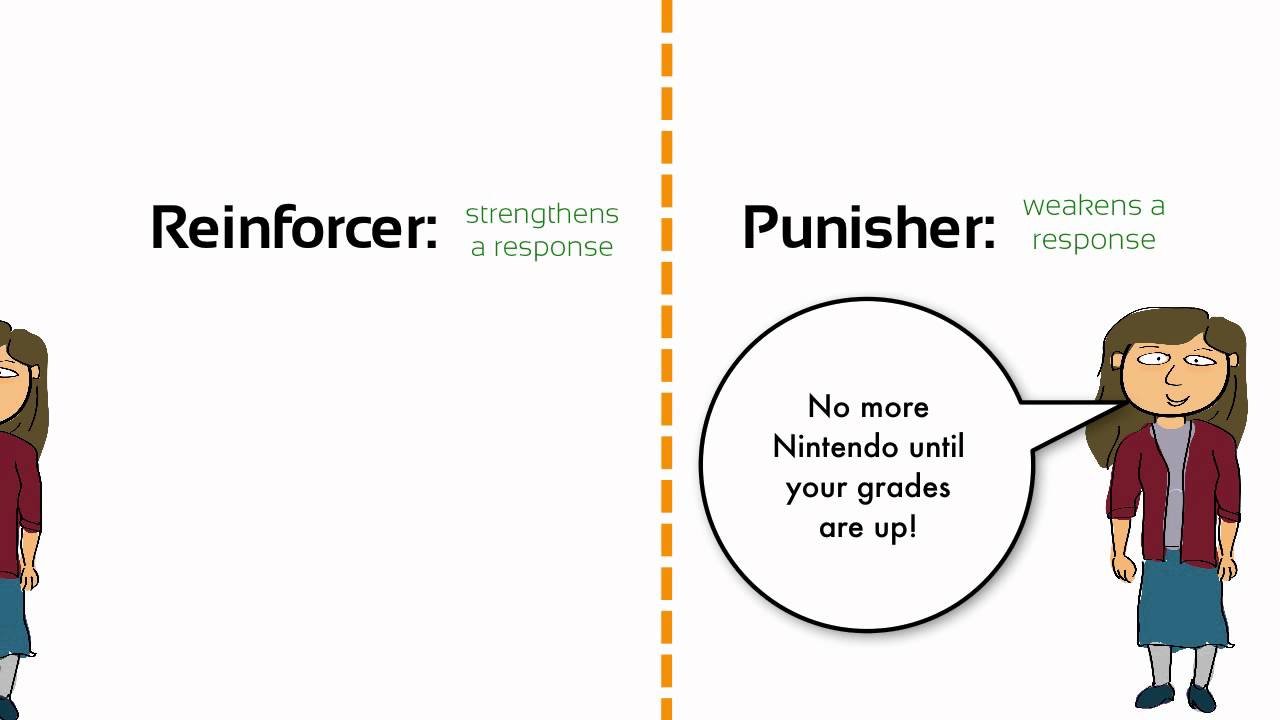
In 1938 B.F. Skinner created the term Operant Conditioning, which is defined as the changing of behavior by the use of reinforcement, which is given after the desired response (McLeod, 2007). Skinner created an operant conditioning chamber known as the Skinner Box to measure the operant conditioning effects on animals including rats and pigeons, “A Skinner box, also known an operant conditioning chamber, is an enclosed apparatus that contains a bar or key that an animal can press or manipulate in order to obtain food or water as a type of reinforcement” (Debell, 1992).  The reinforcements must be given after the desired response to increase or decrease the desired behavior. Skinner identified three types of responses that can follow behavior, these are neutral, reinforcements and punishments.  Neutral operant is a response from the environment that neither increases nor decreases the probability of a behavior being repeated.  A reinforcement, is a response from the environment that increases the probability of a behavior happening again. Reinforcements can be either positive or negative, but both increase a desired behavior.  And punishers are the last kind of response, and are a response from the environment that decreases the likelihood of a behavior being repeated. Skinner’s theory of Operant Conditioning has had lasting effecting in both psychology and academic psychology (Woolfolk, 2013).
Operant conditioning can be used in the classroom to shape performance and can be used in classroom management techniques. Providing feedback can be instrumental in shaping of behaviors or performance in the classroom.  This can be done by the use of affirmation and compliments to give positive reinforcement of good behaviors. Positive reinforcement strengthens a behavior by providing a consequence an individual finds rewarding. Negative reinforcement is the removal of an unpleasant reinforcements can also strengthen behavior. In the classroom negative reinforcements can include: a student being ignored for inappropriate behaviors. Punishments in the classroom to decrease an undesired behavior can include phone calls home for tardiness or being unprepared (McLeod, 2007). Applied Behavior Analysis formed from the operant conditioning theory it refers to Antecedent, Behavior and Consequence, the three building blocks of analyzing and changing challenging or difficult behaviors. Antecedent is the environment the events or behavior that precedes the Behavior of Interest. Behavior has to do with the behavior that you are focusing on, it may lead to other undesirable behavior, or contributes to other undesirable behavior. Consequence is the outcome a child's behavior of choice with the related outcome. Skinner made huge discoveries in the field of psychology, but made advancements in the way learning is considered to happen and how to best aid this.  He believed education had two purposes: to teach verbal and nonverbal behavior and two aid student’s interest in learning.  He thought teachers must know effective ways of teaching based off student’s behaviors.  Skinner believed that for students to learn they must be engaged and motivated to learn not just passively accepting new information, they must be interested. The motivation to learn is different for everyone so you must figure out the best way to motivate and reinforce them to learn (Friedrichs, 1974).
Skinner’s work made vast developments in the field of psychology and academic psychology, and influenced many other psychologist and philosophers after him. Some of the psychologist that came after Skinner that were inspired by his work in behaviorism and operant conditioning include: Kohler, Premack and Bandura. In 1924, Kohler found that primates often seem to solve problems in a flash of insight rather than be trial and error learning. Also social learning theory by Bandura in 1977, suggests that humans can learn automatically through observation rather than through personal experience. Both of these psychologist were influenced and inspired by Skinner’s work and build off of and improved his theories just as Skinner had done with his influences.


References
Day, R. K. (2016). B.F. Skinner, Ph.D. and Susan M. Markle, Ph.D.: The Beginnings. Performance Improvement, 55(1), 39-47. doi:10.1002/pfi.21549
DeBell, C. S. (1992). B.F. Skinner: Myth and Misperception. Teaching  Of Psychology, 19(2), 68.
Friedrichs, R. W. (1974). THE POTENTIAL IMPACT OF B. F. SKINNER UPON AMERICAN SOCIOLOGY. American Sociologist, 9(1), 3.
McLeod, S. A. (2015). Skinner - Operant Conditioning. Retrieved from www.simplypsychology.org/operant-conditioning.html
Watson, J. B. (1913). Psychology as the Behaviorist views it. Psychological Review, 20, 158–177.
Woolfolk, Anita (2013) Educational Psychology (13th ed.) Needham Heights Massachusetts: Allyn and Bacon


Monday, June 6, 2016

Chapter 7 Questions

  1. Reflect on your own learning. What examples of learning qualified as such according to the behaviorist perspective?]
I think the majority of my learning qualified as such according to the behaviorist perspective. Learning is a permanent change in knowledge or behavior due to experience. Everything from wanting to perform well to receive a good grade to the proper ways to act in class were taught by behaviorism. Behaviorism is a change in behavior due to an experience (reinforcement and punishment). A reinforcement is an increase of a desired behavior, an example of this would be studying for a test will make you perform better and receive a good grade. A punishment is a decrease of undesired behaviors, and example of this is being unprepared for class will make the teacher call your parents. Both behaviors are being shaped by their outcomes and the thoughts and experiences related to both.

     2. What is the primary difference between classical and operant conditioning? How might the difference affect learning?
Classical conditioning in an involuntary or automatic behavior (Pavlov's dog). If you normally don't perform well in math, starting a new topic might make you anxious. This behavior is not thought about it is a natural consequence to previous experiences. Operant conditioning uses consequences, rewards and punishments after the behavior. An example of operant conditioning is being rewarded by completing all assignments by having your lowest grade dropped. 

     3. What is the difference between positive reinforcement and negative reinforcement? 
Positive reinforcement is presenting a motivating or reinforcing stimulus after a desired behavior. This then makes the desired behavior more likely to happen in the future. A negative reinforcement is when a certain stimulus is removed after a behavior. This increases future behavior because of removing or avoiding a negative consequence, it is increasing a behavior not decreasing so it is different than a punishment. 
      4.  What is the difference between negative reinforcement and punishment? What are the potential unintended consequences of mixing these up?
A punishment is a decrease of an undesired behavior. While A negative reinforcement is when a certain stimulus is removed after a behavior. This increases future behavior because of removing or avoiding a negative consequence, it is increasing a behavior not decreasing so it is different than a punishment. A negative reinforcement is different than a punishment because it is increasing a behavior not decreasing.